Non Running Car Transport: Move a Car That Won’t Start
05-Nov-2026A car can stop working without warning. One morning it starts fine. The next, you turn the key and nothing happens. Maybe the engine has failed, or an accident has left it undriveable. Maybe you've bought a project car from an auction and it has never run for you.
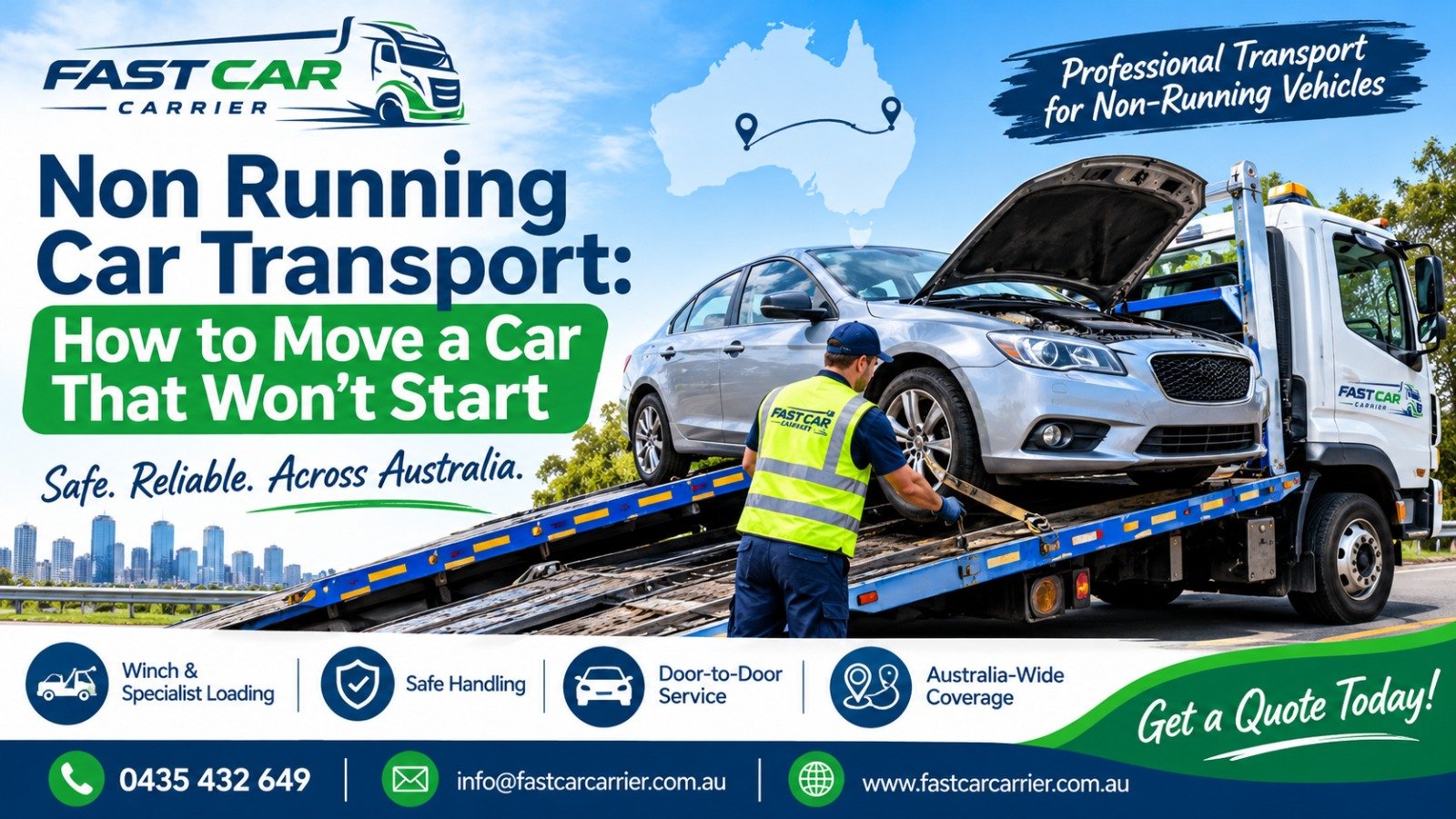
The good news is that a car doesn't need to be running, or even roadworthy, to be moved. Professional non-running car transport is designed for exactly this situation. The vehicle is loaded onto a carrier using the right equipment, then delivered to a mechanic, an auction yard or a new address.
Fast Car Carrier offers non-running vehicle transport across Australia for private owners and businesses. This guide explains how it works, what affects the cost, and how to prepare, so you can book with confidence.
What Is Non-Running Car Transport?
Non-running car transport means moving a vehicle that can't be driven onto a truck under its own power. It might not start, or it might not roll, steer or brake properly.
Standard car transport assumes the vehicle can be driven or rolled onto the carrier. A non-running vehicle often can't. The operator may need extra equipment, extra time and a safe loading plan.
Professional transport is usually a better option than driving or towing the car yourself when:
• the car is unsafe or illegal to drive
• the distance is long, such as an interstate move
• the vehicle is damaged or unregistered
• you don't have the right towing equipment
• you want pickup and delivery handled for you
Can You Transport a Car That Won't Start?
Often, yes. Many different faults can leave a car stuck, and most can be worked around with the right loading method.
Common causes include:
• a flat or dead battery
• engine failure or a seized engine
• transmission problems
• electrical faults
• accident damage
• a car that has sat unused for years
Vehicle Condition | Can It Be Transported? | Important Consideration |
Flat battery | Often possible | Loading equipment may be required |
Engine failure | Often possible | Disclose the mechanical condition |
Accident damage | Depends on damage | Structural damage may affect loading |
Flat tyres | Depends on condition | Special handling may be needed |
Steering failure | Requires assessment | Safe loading and movement must be considered |
Missing wheels | Requires assessment | Suitable equipment and access are essential |
Whether a vehicle can be moved depends on its actual condition and the loading equipment available. That's why an honest description matters so much.
How Is a Non-Running Car Loaded Onto a Transport Truck?
This is the part most people wonder about. A car that won't move still has to get onto the truck safely.
Here are the main tools involved:
Equipment | Purpose |
Electric winch | Pulls the vehicle onto the carrier when it can't move under its own power |
Hydraulic tilt or loading system | Creates a suitable loading angle so the vehicle can be guided on |
Purpose-built carrier | Provides a platform designed for carrying vehicles |
Restraint and securing system | Holds the vehicle in place during transit |
Trained loading operator | Judges the safest way to load each vehicle |
The General Loading Process
The exact method varies, but loading usually follows this pattern:
1. The operator inspects the vehicle and the pickup area.
2. The carrier is positioned and the loading system is set up.
3. The winch is attached to a suitable, safe point on the vehicle.
4. The vehicle is slowly pulled onto the carrier, with the operator watching its path.
5. The vehicle is secured with restraints at multiple points.
6. The operator checks the load before departure.
A winch can pull a vehicle onto the carrier when it can't move on its own. A hydraulic system helps create a gentler loading angle. Together, they allow many non-running cars to be loaded without being driven.
Not every vehicle loads the same way. The method depends on ground clearance, steering, brakes, wheels and access. A low sports car, a car with flat tyres and a car with no steering all need different handling. This is why specialist broken-down car transport Australia drivers ask detailed questions before pickup.
Step-by-Step: How to Arrange Transport for a Car That Won't Start
1. Assess the vehicle's condition. Note whether it starts, rolls, steers and brakes.
2. Contact a suitable transport provider. Choose one that handles non-running vehicles.
3. Share accurate vehicle information. Include make, model, faults and any damage.
4. Provide pickup and delivery addresses. Mention anything that affects truck access.
5. Confirm loading requirements and the quote. Check that the provider understands the vehicle's condition.
6. Arrange pickup access and handover. Make sure someone can be there, with keys if you have them.
7. Complete transport and delivery. The vehicle is carried to its destination and handed over.
Before you book, confirm three things. First, the provider knows the car doesn't start. Second, they can load it with suitable equipment. Third, the quote reflects the real condition of the vehicle.
What Information Do You Need Before Booking?
The more accurate your details, the faster and clearer the quote.
Information | Why It Matters |
Vehicle make and model | Helps identify vehicle size and type |
Vehicle dimensions, if known | Helps assess carrier suitability |
Does the engine start? | Determines loading requirements |
Can the vehicle roll? | Helps plan loading |
Can it steer and brake? | Important for safe movement |
Are all wheels present? | Affects loading arrangements |
Existing accident damage | Helps assess handling requirements |
Pickup address | Helps check access |
Delivery address | Helps plan the route |
Photos of the vehicle | Helps the provider understand its condition |
Be honest and complete. Hiding a fault might seem harmless, but it can cause delays on the day or mean the wrong equipment turns up.
How Much Does Non-Running Car Transport Cost in Australia?
There's no single price. The cost depends on your vehicle and your route, so a personalised quote is the only reliable guide. We won't quote dollar figures here, because they'd be guesses.
These are the main factors:
• transport distance
• vehicle size and weight
• mechanical condition
• whether the vehicle rolls, steers and brakes
• special loading equipment required
• pickup and delivery access
• route availability and carrier scheduling
• additional handling requirements
Cost Factor | How It Can Affect the Quote |
Transport distance | Longer routes generally involve higher transport costs |
Vehicle size | Larger vehicles may use more carrier space |
Loading requirements | Special equipment may affect the quote |
Vehicle condition | Difficult-to-move vehicles may need extra handling |
Pickup location | Restricted access may require alternative arrangements |
Delivery location | Remote or difficult access can affect logistics |
A car that rolls and steers is usually simpler to handle than one that doesn't. Tell the provider everything up front so the quote matches the job.
Can You Transport an Accident-Damaged or Unroadworthy Car?
In many cases, yes. Transport providers regularly move:
• accident-damaged cars
• vehicles with engine damage
• unregistered vehicles
• project and restoration cars
• vehicles awaiting repairs
• auction-purchased vehicles
You must disclose structural damage, leaking fluids, missing wheels, and steering or braking problems. These details change how a vehicle can be loaded safely.
Not every damaged vehicle can be accepted. The provider has to assess whether safe loading is possible. If a vehicle can't be moved safely, a responsible provider will tell you rather than take the risk.
Moving a Non-Running Car to a Mechanic, Auction Yard or New Address
People need non-running car transport for many reasons. Here are the common ones.
Moving a broken-down car to a workshop. Your car fails on a Friday, and your preferred mechanic is across the city. A carrier can collect it from home and take it to the workshop.
Transporting an auction purchase. You win a car at an auction in another city. It may not run, and it may not be registered, so driving it home isn't an option.
Relocating a project car. A restoration car with no engine or no wheels still needs to reach its new garage. Careful loading matters even more here.
Moving an accident-damaged car. After a crash, the vehicle may need to go to a repairer or storage yard. Disclose the damage so the right loading plan can be made.
Interstate moves. Moving house from Victoria to Queensland with a car that doesn't run is a common scenario. For example, you can look at car transport in Melbourne for pickups in Victoria, or Brisbane vehicle transport for deliveries in Queensland. Sydney is another busy hub, with Sydney car transport services available for New South Wales.
Dealership stock. Dealers sometimes buy vehicles that can't be driven. A carrier can move them between yards or from sellers.
Non-Running Car Transport vs DIY Towing
Towing yourself can seem cheaper at first. But it isn't always practical or safe.
Consideration | Professional Car Transport | DIY Towing |
Equipment | Purpose-built transport equipment | Depends on the towing setup |
Long-distance travel | Suitable for planned interstate transport | Can involve significant time and effort |
Vehicle handling | Managed by transport operators | Depends on the driver's experience |
Loading | May use a winch or hydraulic loading system | Requires suitable towing equipment |
Convenience | Pickup and delivery can be arranged | Owner must organise the towing process |
The best option depends on distance, vehicle condition, safety and your circumstances. For a short trip to a local mechanic, a tow may be enough. For a long interstate move, professional transport is usually the more practical choice.
How to Prepare a Non-Running Car for Pickup
A little preparation helps pickup go smoothly.
Task | Why It Helps |
Remove personal belongings | Keeps items safe and the vehicle lighter |
Photograph the vehicle from all sides | Records its condition before transport |
Note existing scratches and damage | Avoids confusion later |
Remove loose exterior items where safe | Prevents parts coming loose |
Keep keys available | Helps with steering lock and handling |
Share mechanical problems | Allows the right equipment to be sent |
Confirm whether it rolls, steers and brakes | Helps plan the loading method |
Mention any fluid leaks | Important for safe loading and handling |
Check the pickup area is accessible | Trucks need room to position and load |
Arrange someone for handover | Someone should be present to release the vehicle |
Don't try unsafe repairs or move a damaged car yourself to "help". If something doesn't feel safe, leave it to the operator.
Why Choose Fast Car Carrier for Non-Running Car Transport?
Fast Car Carrier is an Australian interstate car transport company. Its specialist non-running vehicle transport service is set up for vehicles that can't be driven.
The service features include:
• non-running vehicle transport across Australia
• hydraulic tilt loading systems
• electric winch systems
• experienced loading operators
• purpose-built vehicle carriers
• multi-point vehicle restraint systems
• transport options for damaged and immobile vehicles
• collection and delivery arrangements
• support for private owners and businesses
These features matter because they match the problems a non-running car creates. A winch helps when the car can't move itself. A tilt system helps with the loading angle. Restraint systems hold the car steady on the road. And experienced operators decide what's safe for each vehicle.
Availability and timing depend on your vehicle, route and carrier schedule, so please request a quote for your exact situation.
Common Mistakes to Avoid When Booking Non-Running Car Transport
• Not saying the car won't start. The wrong truck could turn up.
• Hiding accident damage. It affects how the car can be loaded safely.
• Forgetting flat or missing tyres. These change the handling plan.
• Not mentioning steering or brake problems. They affect how the car moves on and off the carrier.
• Giving incomplete pickup details. A truck may not reach a tight street or driveway.
• Assuming every truck can load every vehicle. Some jobs need specific equipment.
• Leaving belongings in the car without approval. Ask first.
• Booking without confirming loading requirements. Check that the provider understands your car's condition.
Frequently Asked Questions
Can I transport a car that won't start?
Often, yes. Many non-running cars can be loaded using a winch or hydraulic system. The provider needs to know the vehicle's condition so they can plan safe loading.
How do you load a non-running car onto a truck?
Operators usually use a winch and a hydraulic or tilt loading system. The vehicle is pulled onto the carrier slowly and secured with restraints. The exact method depends on the vehicle's condition.
Can a car with a dead battery be transported?
Usually, yes. A flat battery often means the car can't move itself, so loading equipment may be needed. Tell the provider when you request your quote.
Can you transport an accident-damaged vehicle?
Often, depending on the damage. Structural damage, leaks or missing parts can affect loading. The provider has to assess whether it can be moved safely.
Can you move a car without wheels?
It requires assessment. Suitable equipment and access are essential, and not every vehicle can be accepted. Share photos and details when you ask.
Can I transport an unregistered car interstate?
Often, yes, because the car is carried on a truck rather than driven. Check with the provider about any requirements for your situation.
Does non-running car transport cost more?
It can, depending on the vehicle and loading needs. Condition, access and equipment all affect the quote. There's no fixed extra fee, so ask for a quote.
Can you collect a broken-down car from a mechanic?
Yes, this is a common request. Make sure the workshop knows a carrier is coming and the vehicle can be released.
Can a non-running vehicle be transported door to door?
Collection and delivery arrangements are available, depending on access. A truck needs safe space to load and unload, so tell the provider about the addresses.
What information should I provide when requesting a quote?
Give the make and model, whether it starts, rolls, steers and brakes, any damage, and photos if you have them. Add the pickup and delivery addresses and your preferred timing.
Conclusion: A Car That Won't Start Doesn't Have to Be a Dead End
A car that won't start can still be moved safely. Professional non-running car transport uses winches, hydraulic loading, purpose-built carriers and secure restraints to move vehicles that can't move themselves.
Be honest about the car's condition, prepare it for pickup, and ask for a quote based on your route. That way, you'll know what to expect before the truck arrives. If you're moving a vehicle across states, the Perth car transport and car transport from Adelaide pages give you more detail on those routes.
Ready to move your vehicle? Contact Fast Car Carrier with your vehicle's condition, pickup location and delivery destination, and request a quote for transport for vehicles that won't start.
Fast Car Carrier
Website: https://www.fastcarcarrier.com.au/
Phone: 0435 432 649
Email: info@fastcarcarrier.com.au