Car Shipping to Perth: Step-by-Step Guide | Fast Car Carrier
08-Oct-2026How Does Car Shipping to Perth Work? Step-by-Step Guide
Shipping a car to Perth can feel complicated. The distance is long. The route crosses some of the most remote country in Australia. And you want to know your car is in safe hands.
People ship cars to Perth for many reasons. You might be:
Relocating to Perth
Moving away from Perth
Buying a car interstate
Selling a vehicle to someone in Perth
Moving a family vehicle
Relocating for work
Sending a second vehicle across
Moving a classic, luxury or special vehicle
Professional car shipping to Perth means you do not have to drive the vehicle thousands of kilometres yourself. You save the fuel, the time off work, the wear on the car and the risk of a long trip.
This guide explains the whole process, from your first quote to the moment you collect the keys in Perth.
How Does Car Shipping to Perth Work?
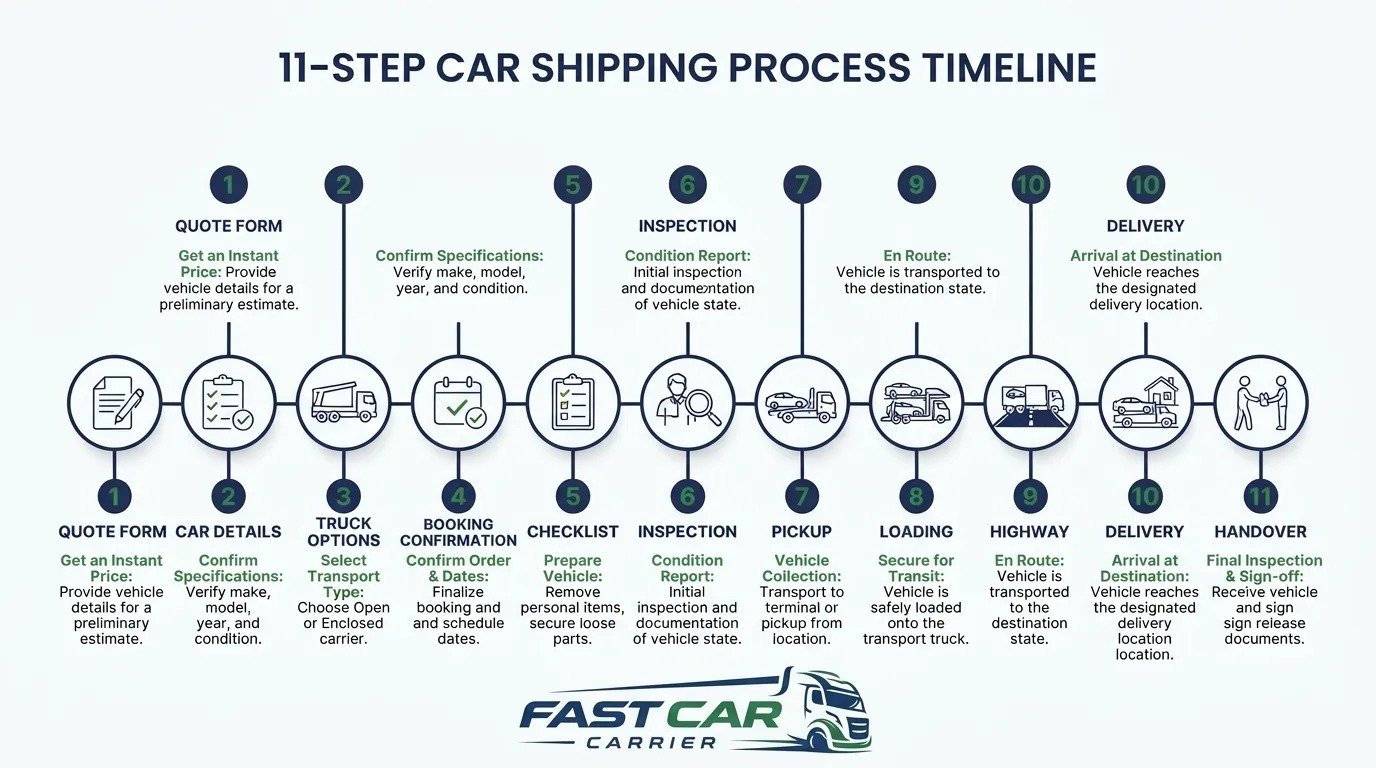
Car shipping follows a clear path. Most bookings move through these stages:
Request a quote. You tell the carrier what you need moved and where.
Provide vehicle and route details. You share the car's details and the pickup and delivery locations.
Choose the transport option. You pick open or enclosed, and door-to-door or depot.
Confirm the booking. You accept the quote and lock in the arrangements.
Prepare the vehicle. You clean it out and record its condition.
Vehicle inspection. The car's condition is checked and noted before handover.
Vehicle pickup. The carrier collects the car from the agreed location.
Loading and securing. The car is loaded onto the carrier and fixed in place.
Interstate transport. The carrier travels the long route towards Perth.
Delivery to Perth. The carrier reaches the delivery area and the car is unloaded.
Final inspection and handover. You check the car and receive it.
The sections below explain each stage in plain terms. If you want a wider overview of how the industry works nationally, the Car Shipping Australia guide is a good companion read.
Step 1: Request a Car Shipping Quote
Every booking starts with a quote request. A quote is only as good as the information behind it. The more accurate your details, the more realistic your quote will be.
Here is what you will normally need to provide:
Pickup suburb or city
Perth delivery suburb or location
Vehicle make and model
Vehicle year
Vehicle condition
Whether the car is running or non-running
Preferred pickup date
Preferred delivery timeframe
Open or enclosed transport preference
Door-to-door or depot service
Any special requirements, such as modifications
Why does this matter? A lifted four-wheel drive takes up more space than a small hatchback. A car that will not start needs different loading equipment. A pickup address on a narrow street may need a different plan.
If these details change after you get a quote, the price or the plan may change too. Being upfront at the start avoids surprises later.
Step 2: Choose the Right Car Transport Option
You will usually choose between two main types of transport. Both can work well. The right choice depends on your car, your budget and how much protection you want.
Open Car Transport
Open carriers are the most common way to move vehicles in Australia. Your car travels on a multi-level trailer that is open to the air.
This option is commonly used for standard vehicles such as everyday sedans, hatchbacks, and SUVs. It is generally the more economical choice.
Enclosed Car Transport
Enclosed transport carries your car inside a covered trailer. This gives extra protection from weather and road debris.
It can suit:
Classic cars
Luxury vehicles
Prestige vehicles
Modified vehicles
High-value vehicles
Enclosed transport generally costs more than open transport. If you are still weighing it up, this guide to open and enclosed car transport explains the differences in more detail.
.
Step 3: Confirm Your Booking
Once you accept the quote, the booking is confirmed. This is when the practical details are locked in.
Expect to confirm:
Booking details. The vehicle, route and transport type.
Pickup arrangements. The address, a contact person and a likely pickup window.
Delivery details. The Perth address and who will receive the car.
Transport requirements. Anything the carrier needs to know, such as a non-running car or modifications.
Communication. How and when the carrier will contact you.
Pickup and delivery dates depend on carrier schedules and route conditions. A carrier may be collecting and dropping off several vehicles on the same journey. Dates are best treated as estimates, not guarantees.
Step 4: Prepare Your Car for Shipping
A little preparation goes a long way. It protects your belongings, keeps the loading process smooth and helps avoid delays on pickup day.
Use this checklist:
Remove personal belongings. Items inside the car are usually not covered by the carrier and can shift in transit.
Remove loose items. Take out toll tags, phone mounts, parcel shelf items and child seats you do not need.
Take photos. Photograph every side of the car, plus the roof, interior and odometer.
Record existing damage. Note scratches, dents and chips so you have a clear starting point.
Check tyre condition. Tyres should hold air and be in a safe condition for loading.
Keep fuel at the recommended level. A low tank is usually enough. Ask your carrier what they prefer.
Leave the required keys. Confirm which keys the driver needs.
Disable alarms where appropriate. An alarm that goes off in transit is a problem for everyone.
Check the vehicle details. Make sure the make, model and year you gave are accurate.
Tell the carrier if the car is non-running. They need to know before pickup.
Mention modifications or unusual dimensions. Lift kits, roof racks and wide tyres can affect how the car fits.
Preparation matters because most avoidable problems come from missing information. For a longer checklist, see this guide on how to prepare your car before shipping.
Step 5: Vehicle Inspection Before Pickup
Before your car is loaded, its condition is checked. This is a simple but important step.
A good inspection looks at:
Existing scratches
Dents
Paint damage
Glass damage, such as chips or cracks
Wheels and tyres
General vehicle condition
The point is to create a clear record of how the car looked at handover. It helps you and the driver agree on its condition.
Take your own dated photographs just before the car is collected. Clear, time-stamped images are a useful reference if you ever need to compare the car's condition on arrival.
This step is a good habit, not a legal or insurance guarantee. If you have questions about cover, ask your carrier and your own insurer.
Step 6: Vehicle Pickup
Pickup is when the carrier takes your car. It can usually happen in a few ways:
Home pickup. The driver collects the car from your street or driveway.
Workplace pickup. Useful if you are not home during the day.
Depot pickup. You drop the car at a set location.
Accessible meeting location. A nearby spot that suits a large truck, such as a wide road or car park.
Car carriers are big. Many are long, tall and heavy, and they need space to move and load safely. Narrow streets, low trees, tight cul-de-sacs and steep driveways can be a problem.
If your address is hard for a large carrier to reach, an alternative pickup point nearby can sometimes be arranged. Tell your carrier about access issues early.
Step 7: Loading and Securing the Vehicle
Once the driver arrives, the loading process begins.
Loading equipment. Most cars are driven up ramps onto the carrier. Hydraulic decks lift and lower levels to suit.
Positioning. The driver places each vehicle in a set position on the carrier. Weight distribution and vehicle height both matter.
Securing. Wheels are strapped or chained down so the car cannot move on the road.
Carrier capacity. A carrier holds a limited number of vehicles. This is one reason scheduling matters.
Non-running vehicles. A car that cannot be driven needs extra equipment, such as a winch. The carrier must know about this in advance.
The driver will normally walk around the car with you, note its condition and confirm the paperwork before you hand over the keys.
Step 8: Interstate Transport to Perth
Then the long journey begins. Perth is one of the longest interstate routes in Australia. From Melbourne it is roughly 3,400 kilometres by road. From Sydney it is closer to 3,900 kilometres. The route crosses large stretches of remote country, including the Nullarbor.
During the journey, the carrier deals with:
Route planning. Drivers plan around major interstate highways.
Multiple vehicle movements. A carrier often picks up and drops off several cars along the way.
Weather. Storms, wind and extreme heat can slow the trip.
Road conditions. Closures and roadworks can force a change of plan.
Traffic. Congestion near capital cities adds time.
Carrier schedules. Drivers must follow rest and work-hour rules.
Pickup and delivery coordination. The carrier keeps in touch so each handover runs smoothly.
It helps to understand two different ideas about time:
Transit time is usually shorter than the overall timeframe. Plan around the overall figure.
How Long Does Car Shipping to Perth Take?
There is no single timeframe that fits every booking. Perth routes generally take longer than shorter east-coast routes because of the distance and the carrier schedules involved.
The estimated timeframe depends on:
Pickup location
Delivery location
Total distance
Carrier schedule
Route availability
Weather
Road conditions
Traffic
Regional or remote locations
Vehicle condition
Transport type
Seasonal demand
A car collected in a capital city and delivered to metropolitan Perth is usually simpler to schedule than one picked up in a regional town. Ask for an estimated timeframe and a typical transit time for your specific route, depending on carrier availability.
For a broader look at how long the process can take, see these notes on interstate car transport timeframes.
How Much Does It Cost to Ship a Car to Perth?
Car shipping prices vary from booking to booking. There is no honest single price for every car and every route.
Here are the main factors that shape a quote:
This is why a personalized quote is more useful than an online "starting from" price. A headline figure ignores your car, your addresses, and your dates. A quote based on your real details is much closer to what you will actually pay.
For more background, see this interstate car transport cost guide.
Can You Ship a Non-Running Car to Perth?
Often, yes. But the carrier needs to know before pickup. A non-running car is loaded differently from one that can be driven.
This can include:
Accident-damaged vehicles. These may have damage that affects steering, wheels, or ground clearance.
Project cars. Half-finished restorations may not have working brakes or an engine.
Vehicles with mechanical problems. These might not start, steer, or stop reliably.
Vehicles that cannot be driven onto the carrier. These are usually winched on.
Winching and special loading equipment take extra time and skill. Access also matters. The carrier needs enough space to position the winch and move the car safely.
Vehicle condition and access can affect both the quote and the loading process. Not every non-running vehicle can be transported without being assessed first. Be honest about the car's condition when you ask for a quote.
Door-to-Door Car Shipping to Perth
Door-to-door service is popular because it is convenient. The carrier collects the car from an agreed location and delivers it to an agreed address in Perth.
Here is how it generally works:
Pickup from an agreed-accessible location. This might be your home, workplace, or a nearby meeting point.
Delivery to an agreed Perth address. The car arrives where you need it.
Convenience. You do not need to travel to a depot.
Road access requirements. The truck needs enough space to reach the location safely.
Alternative meeting points. If a large carrier cannot safely reach a street, you may agree on a nearby spot, such as a wide road or shopping centre car park.
So "door-to-door" does not always mean the exact front door. It means as close as a large truck can safely get. You can read more about how door-to-door car transport works in practice.
What Happens When the Car Arrives in Perth?
Delivery is the last step. Here is how it normally goes:
The carrier reaches the delivery area. The driver will usually contact you before arrival.
Delivery arrangements are confirmed. You agree on the time and the exact spot.
The vehicle is unloaded. The driver removes the straps and brings the car down from the carrier.
The vehicle condition is checked. You walk around the car, compare it with your pickup photos, and review the paperwork.
The vehicle is handed over. Once you are happy, you sign and collect your keys.
The exact delivery point may depend on truck access and the agreed service. If you cannot be there, arrange for someone you trust to receive the car and confirm this with the carrier first.
What Can Delay Car Shipping to Perth?
Most shipments run to plan. But a route this long has many moving parts. These things can cause delays:
Bad weather
Road closures
Flooding
Bushfires
Roadworks
Traffic
Carrier scheduling
Remote locations
Peak periods
Incorrect vehicle information
A vehicle that is not ready at pickup
Special loading requirements
Some of these are outside anyone's control. Others, such as incorrect details or an unprepared car, are avoidable.
That is why you should plan around an estimated timeframe, not a guaranteed arrival date. If you are on a tight deadline, tell your carrier early.
Open vs Enclosed Car Shipping to Perth: Which Should You Choose?
Neither option is always better. The right one depends on your car and what matters to you.
Many people ship everyday cars on open carriers without issues. Others prefer enclosed transport for peace of mind with a valuable car. Think about the car's value, your budget, and how comfortable you are with the trade-offs.
How to Make Car Shipping to Perth Easier
A few simple habits make the whole process smoother:
Book ahead. More notice gives the carrier more scheduling options.
Provide accurate vehicle details. The quote is built on what you tell the carrier.
Confirm addresses. Double-check pickup and delivery locations, including access.
Prepare the vehicle early. Do not leave cleaning out the car to the morning of pickup.
Take condition photos. Do it before handover while the car is clean.
Remove belongings. Clear the car of anything personal or loose.
Tell the carrier about the non-running status. They need to plan the right equipment.
Keep contact details available. Drivers may need to reach you at short notice.
Ask about the estimated timeframe. Know what to expect for your specific route.
Confirm the selected transport method. Check if you are booked on open or enclosed as you intended.
Who Uses Car Shipping to Perth?
People use car shipping for many reasons. Here are some common situations.
Interstate movers. Moving house across the country is stressful enough without a 3,000-kilometer drive. People moving the other way can look at Perth to Melbourne car transport for that route.
Families. Shipping the family car lets everyone fly and settle in rather than spend days on the road.
Workers relocating. Start your new job without the long drive.
Students. A student moving to study in Perth may want to bring their car without driving it across the Nullarbor.
Car buyers. You may find the right car interstate and need it delivered to Perth.
Car sellers. A buyer in Perth may need your car delivered after purchase.
Dealerships. Dealers move stock between locations.
Businesses. Companies relocate fleet vehicles or work cars.
Classic car owners. Valuable or sentimental cars often suit enclosed transport.
Owners of non-running vehicles. Project cars and damaged vehicles can often be moved with the right equipment.
If you are moving from Melbourne, this guide to Melbourne to Perth car transport covers that popular route.
Frequently Asked Questions
How does car shipping to Perth work?
You request a quote, choose a transport option, and confirm the booking. Then you prepare the car and hand it over for pickup. It is loaded, secured, and transported interstate. At the other end, it is unloaded in Perth and handed over after a condition check.
How much does it cost to ship a car to Perth?
It varies. Distance, vehicle size, running condition, transport type and carrier availability all affect the price. The best way to know is to request a personalized quote for your car and route.
How long does car shipping to Perth take?
There is no single timeframe for every booking. It depends on the route, carrier schedule, weather, road conditions, and other factors. Ask for an estimated timeframe for your specific pickup and delivery locations.
Can I ship a non-running car to Perth?
Often, yes. But tell the carrier before pickup so the right loading equipment can be arranged. Condition and access can affect the quote and the loading process.
Can I get door-to-door car transport to Perth?
Yes. Door-to-door service collects the car from an agreed location and delivers it to an agreed Perth address. If a large carrier cannot safely reach a street, a nearby meeting point can usually be arranged.
Is open or enclosed transport better?
Neither is always better. Open transport is generally more economical and suits most standard cars. Enclosed transport offers extra protection and suits classic, luxury, or high-value vehicles.
What should I remove from my car before shipping?
Remove personal belongings and loose items. Take out anything valuable, plus things that could move or fall in transit.
Can I ship a car from Melbourne to Perth?
Yes. Melbourne to Perth is a well-traveled route. Carrier availability and timing will vary, so request a quote for your dates.
Can I ship a car from Sydney to Perth?
Yes. Sydney to Perth is a longer route again, so scheduling and price may differ. A quote based on your actual pickup location is the best guide.
What information do I need for a car transport quote?
You will need your pickup and delivery locations, vehicle make, model and year, whether it runs, your preferred dates, transport type and any special requirements.
Ready to Ship Your Car to Perth?
Shipping a car across the country does not have to be stressful. Once you understand the steps, the process is far more straightforward than it looks.
If you would like a quote based on your actual vehicle, pickup location and Perth delivery location, get in touch with the team at Fast Car Carrier.
Fast Car Carrier
Phone: 0435 432 649
Email: info@fastcarcarrier.com.au
Website: https://www.fastcarcarrier.com.au/